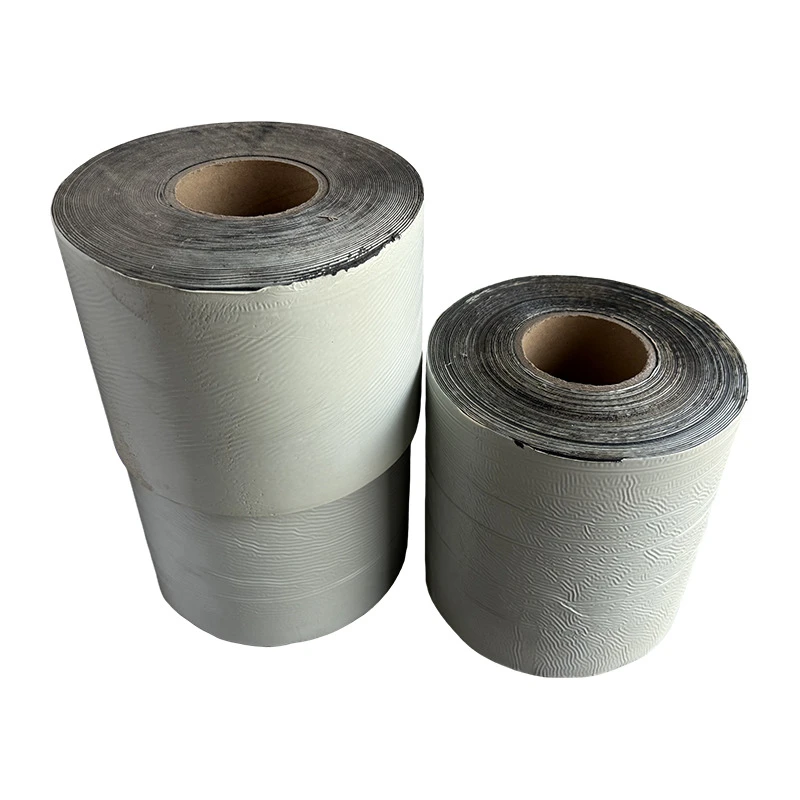
Viscoelastic anti-corrosion tape is a type of anti-corrosion material designed based on special materials. Its name "viscoelastic" comes from the material's combination of both adhesive and elastic mechanical properties. Unlike common high-density polyethylene tapes, the molecular structure of viscoelastic materials allows them to remain flexible over a wide temperature range, without hardening or cracking even after long-term use. This physical characteristic directly relates to the durability of its anti-corrosion effect.
In terms of material composition, viscoelastic anti-corrosion tape typically consists of a substrate, a viscoelastic adhesive layer, and a release liner. The substrate is often made of woven polypropylene, providing mechanical support; the viscoelastic adhesive layer is the core functional layer, mainly composed of butyl rubber, polyisobutylene, and filler oils, which work together to form a non-curing colloid; the release liner protects the adhesive layer before application. Compared to rigid anti-corrosion layers such as epoxy coatings, the self-healing ability of viscoelastic is a significant difference: when the coating is subjected to external forces and suffers minor damage, the material can slowly flow to fill the gaps.
From the perspective of its working principle, the anti-corrosion mechanism of viscoelastic tape includes both physical sealing and chemical isolation. Physically, the material adheres tightly to the metal surface, completely isolating it from moisture and oxygen. Chemically, the corrosion-inhibiting components in the adhesive layer are released in trace amounts, forming a protective film on the metal surface. Compared to fusion-bonded epoxy powder coatings, which require strict surface treatment, viscoelastic materials have lower surface treatment requirements and maintain adhesion even on damp surfaces, reducing limitations in the construction environment.
The key technical points during construction reflect the material's application characteristics. A certain tension must be maintained during wrapping to ensure sufficient overlap, but no heating or special curing treatment is required. Compared to heat-shrink sleeves that require baking and curing, viscoelastic tape can be applied at room temperature and provides a better fit for irregular areas such as valves and flanges. Although its material flow is slow, it is sufficient to automatically fill surface depressions, thus reducing manual processing.
Regarding long-term performance, the aging rate of viscoelastic tape is significantly affected by ultraviolet radiation, therefore it is usually used in conjunction with an external protective layer. In buried pipeline environments with frequent changes in soil stress, the material's elasticity allows it to adapt to a certain degree of deformation without cracking. In contrast, rigid anti-corrosion layers are prone to stress cracking when soil displacement occurs. It is worth noting that viscoelastic materials are sensitive to high-temperature environments; continuous exposure to temperatures above 60°C may lead to excessive softening, unlike high-temperature resistant ceramic coatings.
Environmental adaptability is a crucial aspect of this material. In regions with significant temperature differences, viscoelastics, with a thermal expansion coefficient similar to steel, are less prone to peeling due to temperature cycling. In marine salt spray environments, their resistance to chloride ion penetration is superior to some organic coatings. However, like all polymer materials, their resistance to chemical solvents is limited; strong solvent environments may cause swelling.
Practical applications require material selection based on specific conditions. Viscoelastic tapes demonstrate unique advantages in areas such as the repair of old pipelines where complete rust removal is difficult, and the corrosion protection of irregularly shaped components. However, in high-temperature pipelines, strong solvent environments, or situations requiring extremely high mechanical strength, other anti-corrosion solutions must be comprehensively evaluated. Material thickness selection must consider the corrosion environment level; harsher environments require increased thickness or the use of other protective measures.
From a materials development perspective, viscoelastic technology continues to improve. Recent research directions include improving temperature resistance, enhancing UV resistance, and developing environmentally friendly formulations. Compared to earlier versions, the current product shows significant improvements in long-term adhesive stability, while maintaining the same fundamental principles. Future development may include the research and development of smart viscoelastic materials that can produce a monitorable response to changes in corrosive environments.
In summary, the technical characteristics of viscoelastic anti-corrosion tape determine its application boundaries. This material is valuable for handling complex shapes, damp surfaces, and dynamic stress environments, but its physical properties also limit its application in special scenarios such as high temperatures and strong solvents. Material selection should be based on a systematic evaluation of the specific corrosive environment, application conditions, and long-term maintenance requirements, rather than a comparison of a single performance parameter.